Built for Buyers Who Mean Business
- Shopify Plus native B2B covers company accounts, catalogs, payment terms, and quantity rules.
- Custom wholesale portals add quick order forms, tiered pricing logic, and account based workflows.
- ERP integration is the single biggest technical decision in any serious B2B build.
- Forrester named Shopify a Leader in B2B Commerce in 2024; B2B features keep expanding every release.
B2B on Shopify used to mean running two storefronts, jury rigging apps, or building something custom from scratch. That is no longer true. Shopify Plus now ships with a proper B2B feature set and the gap between what is native and what needs customization keeps shrinking.
Here is what B2B looks like on Plus today, what we build for clients on top of it, and the questions we ask before starting any serious wholesale project.
Native Shopify Plus B2B: what you get out of the box
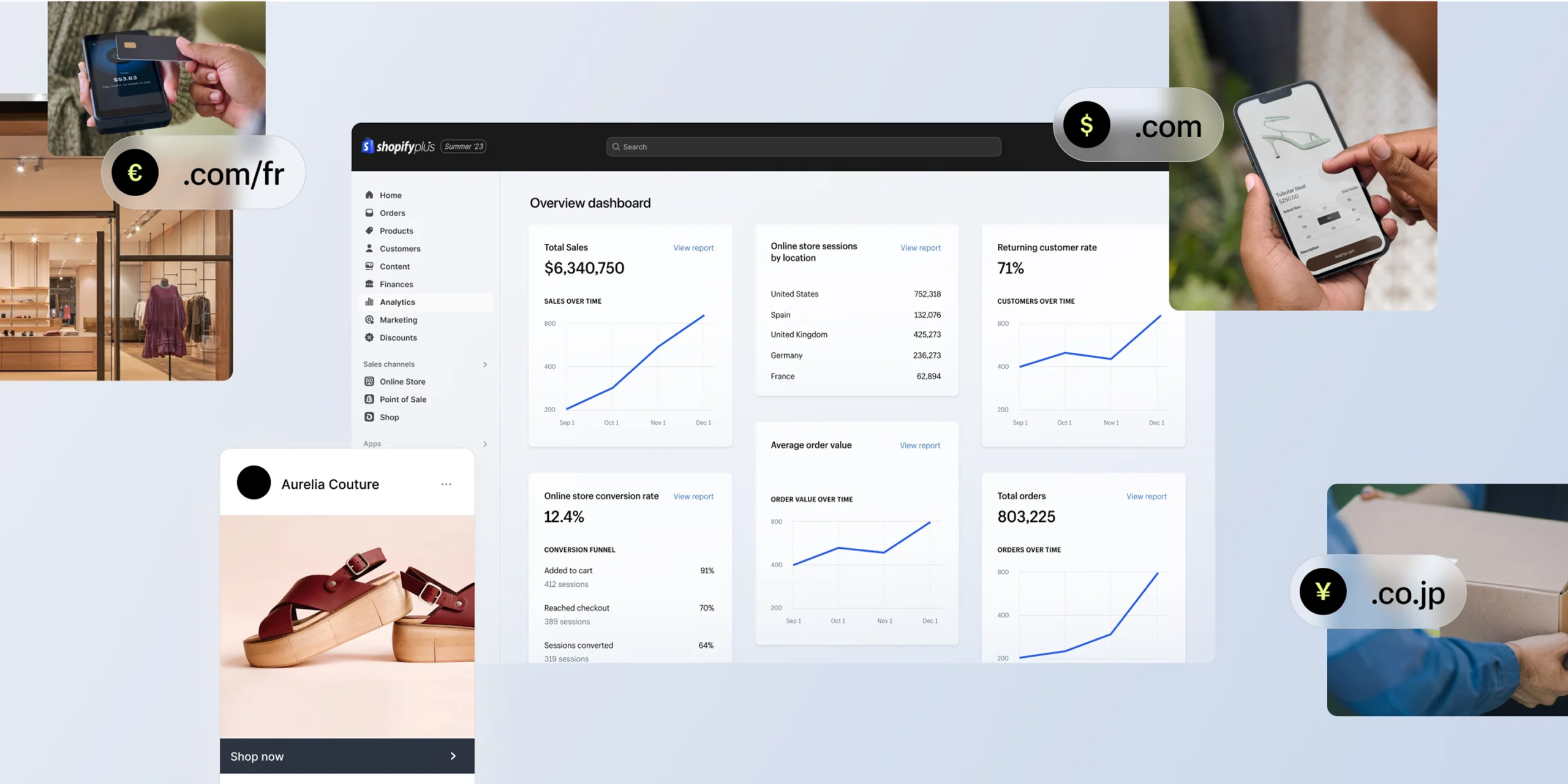
Shopify’s native B2B suite handles more than most merchants realize. Company accounts let you model real organizations with multiple buyers, locations, and roles. Catalogs control which products and prices each company sees. Payment terms support net 30, net 60, or any custom arrangement. Quantity rules and volume pricing handle minimums and tiered pricing.
Shopify was named a Leader in the 2024 Forrester Wave for B2B Commerce Solutions, and B2B has been a headline feature in every recent Plus edition. For a lot of distributors, what ships natively is already enough to replace their old B2B portal.
Where custom work pays off
Native B2B is a strong starting point, but most of our wholesale clients need something beyond it. These are the customizations we build most often.
- Quick order forms. SKU based forms where a buyer can paste in a list of codes and quantities, skip the product pages, and check out in seconds.
- Account based catalogs and pricing. Different catalogs, different price lists, different terms per company, driven by ERP data rather than manual tagging.
- Quoting workflows. Draft orders, approval chains, and PDF quotes that sync back into the ERP once accepted.
- Credit limits and order holds. Logic that checks a company’s outstanding balance before an order can progress.
- Multi location ordering. Company accounts that ship to different branches, each with its own pricing and shipping rules.
- Custom checkout for B2B. Purchase orders, project references, freight terms, and compliance fields that do not exist in the consumer checkout.
ERP integration is the real decision
Every serious B2B build eventually comes down to the ERP. NetSuite, Dynamics 365, SYSPRO, Sage, or whatever legacy system is already running the business. If your Shopify store and your ERP are not in sync on pricing, inventory, and customer data, your wholesale portal becomes a liability instead of an asset.
We approach this two ways. Real time API integration is the ideal when the ERP supports it. For systems where real time is not possible, we build resilient scheduled syncs with error handling and reconciliation. The choice drives a lot of the project cost and timeline, which is why we ask about the ERP in the first conversation.
If you are looking at B2B on Shopify, the first question is not about features. It is about your ERP and your customer data. Get those right and the rest follows. Get them wrong and no amount of custom work fixes it.
We’ve Done This Before

Barr Plastics
Shopify 2.0 B2B rebuild with custom quoting tools, streamlined product discovery, and UX redesign for an industrial supplier.
View Case Study
Protected: Coast Appliances
There is no excerpt because this is a protected post.
View Case Study
Protected: Canada Trac Parts
There is no excerpt because this is a protected post.
View Case StudyBook a B2B Consultation
Tell us about your current wholesale process, your ERP, and your pain points. We will map where native B2B fits and where custom work pays off.