
Quick Takeaways
- Magento to Shopify Plus migrations are among the most complex ecommerce replatforming projects because of Magento’s deep customization and server-side architecture
- The biggest risks are losing SEO value from poor redirect mapping and breaking custom functionality that was built directly into Magento’s codebase
- A typical Magento to Shopify Plus migration takes 12 to 20 weeks depending on catalog size, custom features, and third-party integrations
Migrating from Magento to Shopify Plus is one of the most involved ecommerce replatforming projects a brand can take on. Magento stores tend to be heavily customized, with years of extensions, custom modules, and server-side logic built into the platform. Moving all of that to Shopify Plus requires careful planning, not just data transfer.
We have managed Magento to Shopify Plus migrations for brands with catalogs ranging from a few hundred products to tens of thousands. The complexity is never just about the product data. It is about the custom functionality, the URL structure, the integrations, and the team’s readiness to operate on a new platform.
Why Brands Are Leaving Magento
Magento 1 reached end of life in June 2020, and Adobe Commerce (formerly Magento 2) carries significant hosting, maintenance, and development costs. Many brands find themselves spending more on keeping Magento running than on actually growing their business. Shopify Plus eliminates server management, reduces ongoing development overhead, and provides a more stable foundation for scaling.
The Biggest Migration Risks
SEO is the number one risk. Magento and Shopify use completely different URL structures. If you do not create comprehensive 301 redirects for every indexed page, including products, categories, and CMS pages, you will lose organic traffic. We build redirect maps before anything else in a Magento migration because recovering lost SEO rankings after a bad migration can take 6 to 12 months.
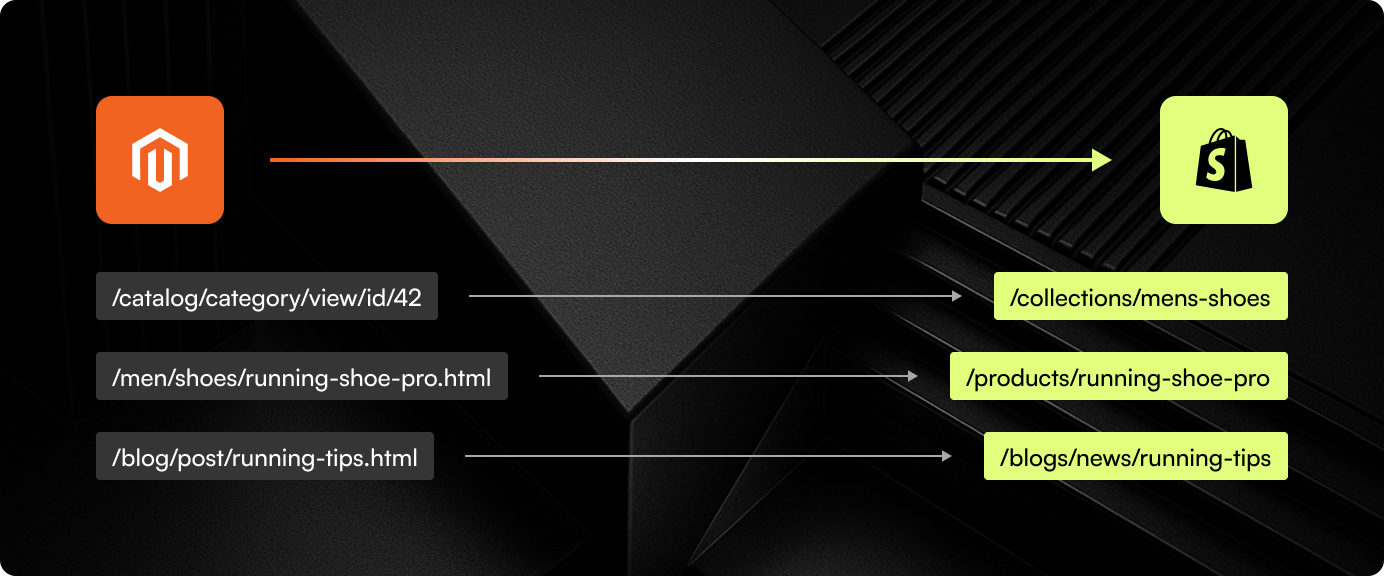
Custom functionality is the second risk. Magento stores often rely on custom modules for things like complex pricing rules, B2B access controls, advanced product configurators, or multi-warehouse inventory logic. Each of these needs to be evaluated: can it be replaced by a Shopify app, does it need custom Shopify development, or can it be retired?
What the Migration Process Looks Like
A typical Magento to Shopify Plus migration follows this path: discovery and scoping (2 to 3 weeks), data mapping and redirect planning (2 to 3 weeks), theme design and development (4 to 6 weeks), integration setup (2 to 4 weeks), data migration and QA (2 to 3 weeks), and launch. Total timeline is usually 12 to 20 weeks depending on complexity.
The stores that have the smoothest migrations invest the most time in the discovery and planning phases. Rushing past those steps to get to development faster almost always results in problems at launch.
Getting Started
If you are considering a move from Magento to Shopify Plus, start with an honest assessment of what your current store does, what you actually need going forward, and what can be simplified. Not every Magento feature needs to be replicated on Shopify. Sometimes a migration is a chance to clean house.
We’ve Done This Before

Erik’s Bike Board & Ski
VTEX to Shopify Plus 2.0 migration with custom filtering, mobile-first UX, and a 27% conversion lift for a cycling retailer.
View Case Study
Surplus City
Shopify Plus 2.0 migration with streamlined inventory, modernized UX, and scalable operations for a liquidation retailer.
View Case Study
The Boardroom
High-performance Shopify 2.0 migration with editorial design and culture-driven UX for a premium action sports retailer.
View Case StudyReady to move off Magento?
We handle Magento to Shopify Plus migrations from scoping through launch. Let’s talk about your store.